


Más Información








Project Event Horizon Telescope (EHT)
, in which eight Mexicans participated, has won the Breakthrough Prize , best known as the “Oscars of Science” in the category of Fundamental Physics , thanks to the first image of a black hol e.
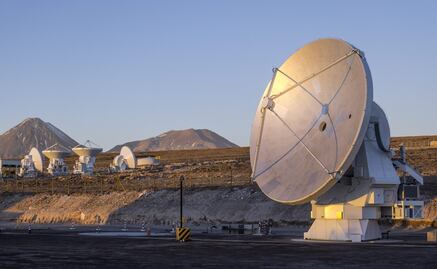
According to information of the Scientific Advisory Forum , to capture the first image of a supermassive black hole, the alliance of 8 sensitive radiotelescopes was needed, located strategically all over the world: the Antartic, Chile, México, Hawaii, Arizona, and Spain ; in addition to all the global collaboration of scientists from 60 institutions operating in 20 countries and regions to create a virtual telescope the size of the Earth with a resolution power never reached before from the surface of our planet.
The prize consists of USD $3 million and it will be shared equally between the 347 scientists who participated in the project. It will be presented next November 3rd in a ceremony organized by the Breakthrough Prize Foundation , headed by Sergey Brin, Priscilla Chan, Mark Zuckerberg, Ma Huateng, Yuri and Julia Milner .

Laurent Loinard
, a researcher of the Institute of Radioastronomy and Astrophysics (IRyA) of the National Autonomous University of Mexico (UNAM), participated in this great international project. The UNAM researcher and three of his postgraduate students contributed to the feat. Currently, his students are doing postdoctorate stays in Germany and will also receive the prize.
“Right now, I’m the only one from UNAM, because my students Sergio A. Dzib, Antonio Hernández-Gómez, and Gisela N. Ortiz-León are doing an academic stay, but they wrote to me and are very happy, they can’t believe they will receive the prize too. There is also the team of the National Institute of Astrophysics, Optics, and Electronics (INAOE), ” added the academic.
One of the first objectives of the Event Horizon Telescope project was to capture the supermassive black hole at the center of the Messier 87 galaxy . Its mass is equivalent to 6.5 billion stars like our Sun . After carefully analyzing the data with algorithms and new techniques, the team created an image of this gigantic galactic body, cut against the hot gas around it.
This prize recognizes scientists of excellence in the world in the fields of Life Sciences, Fundamental Physics, and Mathematics. On its 8th edition , the topic is “To See the Invisible,” inspired by the Event Horizon Telescope collaboration which showed the greatest power of science and mathematics to reveal hidden and unexplored worlds.

mp

Noticias según tus intereses
[Publicidad]
[Publicidad]