[Publicidad]


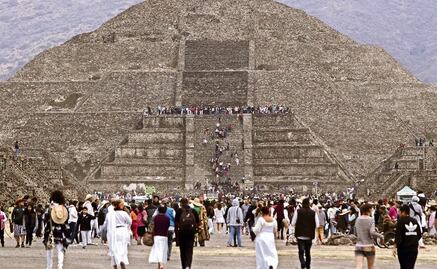
A team of archaeologists has discovered the remains of a mural and several objects at the Plaza of the Columns complex which seem to indicate that a part of the Mayan elite resided in the pre-Hispanic city of Teotihuacán , northeast of Mexico City .
Several fragments of Mayan pottery, a lavish offering, and a deposit with thousands of skeletal remains were found in the area, located between the Sun and Moon pyramids.
Mexico’s National Institute of Anthropology and History (INAH)
pointed out that the findings confirmed the theory that both cultures were related, despite being 1,300 kilometers away from each other .
“A number of epigraphic texts located in places such as Tikal and Petén indicate that there was a close contact between both cultures around the 4th century AD . However, little evidence of this theory had been found in the great city of the Mexican Plateau until recently, when new findings indicated that an elite Mayan group resided in the City of the Gods.
The team of archaeologists led by doctors Saburo Sugiyama, Verónica Ortega Cabrera, Nawa Sugiyama, and William Fash based on the assumption of the Mayans’ importance for the political organization of Teotihuacán.
[Publicidad]
The Plaza of the Columns project seeks to unveil mysteries about the city’s origins, history, and transformation, as well as its multi-ethnic relations.
dm

[Publicidad]